Dr. Zsolt Bedő, the leader of the Settlement-level Circular Economy Monitoring and Modelling System – Innovation, Financing, Economic Impact Research Group at the University of Pécs, participating in the National Laboratory for Renewable Energy (NLRE) project, shares his insights.
The research group established a multidisciplinary collaboration in which different economic, engineering and natural science approaches met. During the collaboration, this combination of approaches was applied to examine the economic, social and infrastructural impacts of hydrogen technology. The group began developing the modelling methodology, as well as preparing Environmental, Social and Governance (ESG) based and resilience-based analyses to support urban and corporate sustainability decisions.
Within the framework of the project, a hydrogen-based mobility and infrastructure modelling framework was developed, enabling detailed examination of various economic and technological scenarios. The model can also be complemented with ESG- and resilience-oriented analyses, thereby contributing to the foundation of sustainable development pathways.
Thanks to the project, hydrogen technology has appeared in economic research as well, and a new knowledge base has been created that can be developed long-term.
The research group's study, published in the journal of Economic Review (Közgazdasági Szemle), is available at the following link: https://real.mtak.hu/209577/7/Kszemle_CIKK_2217.pdf
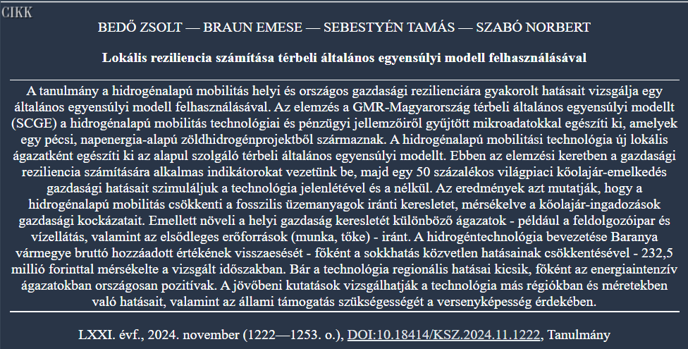
Article by Bedő et al., appeared in the journal of Economic Review, entitled:
„Calculating local resilience using a spatial general equilibrium model”
